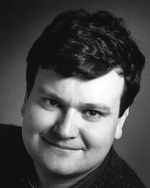
Tom Henzinger is a Professor of Electrical Engineering
and Computer Sciences at the University of California, Berkeley.
He holds a Dipl.-Ing. degree in Computer Science from Kepler University in
Linz, Austria, an M.S. degree in Computer and Information Sciences from the
University of Delaware, and a Ph.D. degree in Computer Science from Stanford
University (1991).
He was an Assistant Professor of Computer Science at Cornell University (1992-95),
and a Director of the Max-Planck Institute for Computer Science in Saarbruecken,
Germany (1999).
His research focuses on modern systems theory, especially formalisms and tools
for the component-based and hierarchical design, implementation, and verification
of embedded, real-time, and hybrid systems. His HyTech tool was the first model
checker for mixed discrete-continuous systems.
ABSTRACT
A hybrid system is a dynamical system whose state
has both a discrete component, which is updated in a sequence of
steps, and a continuous component, which evolves over time. Hybrid
systems are a useful modeling tool in a variety of situations,
including control, robotics, circuits, biology, and finance.
We survey a computational approach to the design and analysis of hybrid systems
which is based on the symbolic discretization of continuous state changes.
On the theoretical side, we classify infinite, hybrid state spaces as to which
finite, discrete abstractions they admit. This classification enables us to
apply concepts and results from concurrency theory, model checking, and game
theory to hybrid systems. On the practical side, we discuss several options
for implementing the symbolic approach to hybrid systems, and point to existing
tool support. |