

Students: Sonjai Gupta
Faculty Research Assistant: Yannis Konstantopoulos
Professor: Anthony Ephremides
Project Background and Goals
The objective of this project is to evaluate the performance of different bandwidth allocation algorithms for LANs interconnected via satellite.
Satellite interconnected or hybrid LANs have certain advantages over terrestrially connected LANs. A satellite can be used to interconnect LANs located in remote areas, and in a hybrid situation can be used for large data-file transfers, so at to avoid over-burdening the terrestrial networks.
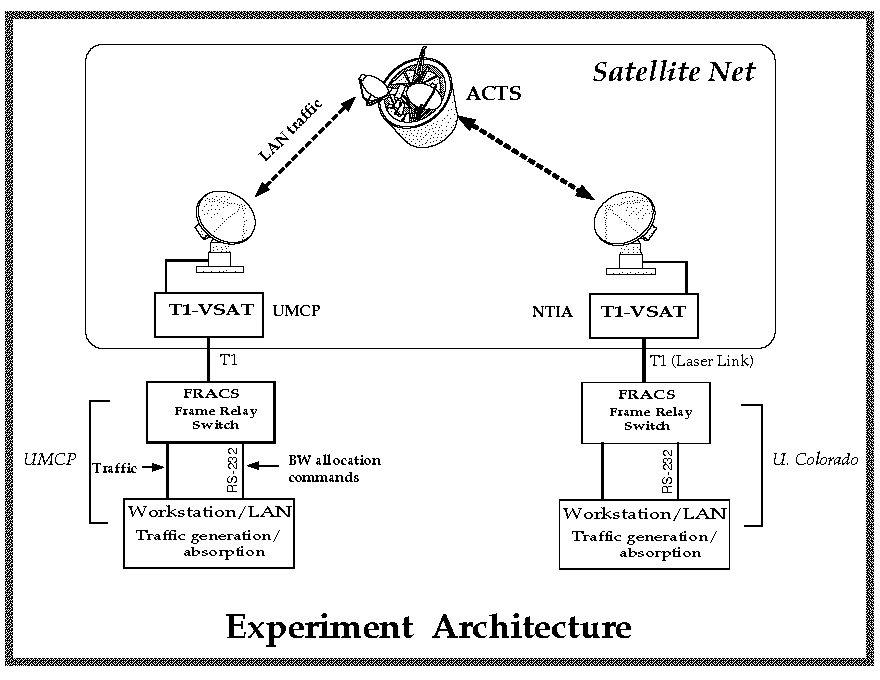
However, satellite bandwidth is costly. Thus, in order to utilize it optimally, we plan to test some bandwidth allocation algorithms which will aim to minimize both the bandwidth used and the network congestion. These algorithms will observe the incoming traffic and accordingly adjust the satellite bandwidth by sending out bandwidth addition/deletion requests to the ACTS satellite.
Description
Traffic consisting of both data and voice calls will be transmitted. For the data we will be using a Markov Modulated Poisson Process (MMPP) as one of the traffic models. Also used will be a pseudo-random shift register, whose output at each time instant will determine wether or not a packet is transmitted. Voice calls will be of an exponential duration, and will have exponential inter-arrival times.
Frame-Relay will be implemented over the satellite channel by using a frame relay switch (FRACS). The FRACS (Frame Relay and Circuit Switch) will act as an interface between the traffic source (the workstation) and the T1-VSAT.
The experiment will evaluate the performance of at least three different types of bandwidth allocation algorithms. These will include a rate-based algorithm, a buffer-occupancy based algorithm, and a predictive buffer-occupancy based algorithm. The rate-based algorithm will be implemented by the FRACS. Using this algorithm all the BW allocation decisions will be functions of the incoming and outgoing data rates from the FRACS. This algorithm will be disabled to allow the execution of the buffer-occupancy based algorithms, executed from within the workstation.
The first buffer-occupancy based algorithm will place allocation requests as a function of the number of packets waiting in the buffer. The predictive algorithm will, on the other hand, attempt to predict the number of buffered packets for a future time-instant, and will do the allocation accordingly.
The ACTS latency delay, i.e. the time after a request has been placed & until it goes through, is highly variable. It can vary from 2, all the way to 15 seconds, depending on such factors as the total load on the satellite, the total number of requests coming in from all the different users, etc. Since these factors are out of our control, the experiment has been divided into two parts to allow a fair comparison of the various algorithms.
The first part will place the latency time under our control. All the 24 satellite channels (T1 rate, at 64 kbits/sec per channel) will be acquired at the start of the experiment. However, data will only be sent on the 'assigned` channels. The 'unassigned channels will carry 'junk' data. The boundary between the 'assigned' and the 'unassigned' channels will be maintained in software. This way, when a need is felt of additional BW, the boundary can be shifted either instantaneously, or after an artificial delay (to simulate different, but constant, latency delays).
In the second part, bandwidth will be acquired on an as-needed basis to observe the effectiveness of the different allocation algorithms, operating under the conditions of a varying latency delay.
Status
The basic software setup of the experiment is nearly complete, and simulations are being run between two local computers on the ethernet, to determine such experiment parameters as the number of packets needed to reach steady state, optimum queue size, location of buffer thresholds, etc. Work is also progressing on the implementation of an MMPP source and a predictive allocation algorithm.