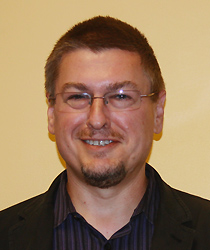
Simon, Jonathan
The Institute for Systems Research
Biology
Brain and Behavior Institute
Jonathan Simon's expertise is applied and theoretical neuroscience, with emphasis on auditory neuroscience. His research focuses on neural processing in the brain's auditory system, from specialized processing found only in humans (e.g., speech processing) to generalized processing found in most mammals, including auditory attention and sound localization.
He earned his bachelors in physics from Princeton University, his doctorate in physics from the University of California, Santa Barbara, and did postdoctoral research in theoretical general relativity (University of Wisconsin-Milwaukee, and University of Maryland-College Park) before embracing the field of neuroscience. He joined the University of Maryland's Electrical and Computer Engineering Department in 2001, the Biology Department in 2002, and the Institute for Systems Research in 2013. Simon is co-director of the KIT-Maryland Magnetoencephalography Center, and of the Computational Auditory Neural Systems Laboratory (CANSL).
REACH Student Wins Prestigious ARO Scholars Award
Stella Alumonah named an ARO Scholar for her contributions to auditory neuroscience and selected as one of four recipients nationwide.UMD Student Improves Speech-Brain Analysis with Automated Word Alignment Tools
Electrical Engineering Student Advances Speech Neuroscience Through Automated Audio Alignment ResearchHow the Brain Builds Meaning from Sound
A new study from UMD’s Institute for Systems Research offers hope for improving hearing technology and supporting individuals with speech and language challenges.Research by Jonathan Simon Supported by KU Leuven Global Seed Fund
Will study neural mechanisms underlying human oral communication‘Priming’ helps the brain understand language even with poor-quality speech signals
New research published in PNAS shows word representations may provide some objective measures of speech comprehension.New UMD Division of Research video highlights work of Simon, Anderson
The researchers use magnetoencephalography to understand and develop training for aging-related signal processing interactions between the ears and the brain.Graduate students win ISR and ECE awards
Awards given for outstanding performance, teaching, and dissertation work.ECE Junior Tejas Guha published as first author in eLife Journal
Article discusses creating accessible visualizations in bioinformatics researchDiscovering a digital biomarker for post-stroke cognitive problems
Funding for a noninvasive, inexpensive screening tool that could predict persistent post-stroke cognitive difficulties.2023 BBI Seed Grants Inspire New Interdisciplinary Collaborations
The six interdisciplinary teams will use state-of-the-art neuroscience tools to translate basic science research into real-world impact.Jonathan Simon Awarded $149,000 Seed Grant
Study will address auditory issues in aging and bilingual populationsGiving back: New solar panels support a local urban farm
Clark School staff, students and faculty help historic Silver Spring produce farm become more sustainable.New robust and scalable computational methodology developed by UMD researchers helps identify directed connectivity within the brain
‘NLGC’ can be used with magnetoencephalography to better understand the neural mechanisms behind sensory processing.Jonathan Simon gives keynote address at international cognitive hearing science conference
Simon spoke on “The progression of neural speech representations through auditory cortex and beyond, from acoustics to semantics.”Congratulations to our December 2021 ISR graduates!
ISR advisors graduated 22 Ph.D., 2 M.S., and 4 M.S.S.E. new alumni in December!How does the brain turn heard sounds into comprehensible language?
$2.88M in NIH funding could lead to brain-aware, tunable hearing devices.The brain makes sense of math and language in different ways
Distinct regions in the brain use their own neural pathways and networks to process either spoken math or language.Seven Students Win 2021 Dean's Research Awards
From fabricated human tissue to Wifi beamed from space, awards recognize cutting-edge researchNIH grant furthers poststroke recovery research of Marsh, Simon
MEG scans will help determine the neurophysiologic effects of mindfulness training on subacute post-stroke depression and cognition.Congratulations, May 2021 ISR graduates!
Institute for Systems Research faculty advised PhD, MS, BS and 12 MSSE students who graduated in May 2021.ECE Names 2020-2021 Distinguished Dissertation Fellows
The fellowships are awarded to outstanding students in the final stages of dissertation work in recognition of their research excellence.Emerging from the fog: Little understood post-stroke cognitive issues verified
For the first time, researchers measure the physical evidence of diminished neural processing within the brain after a stroke.Fu, Marcus team for new AFOSR project on simulation optimization
Simulation optimization aims to guide planning and decision making under uncertainty in complex dynamic settings.New algorithms for estimating the latent dynamics underlying biological processes
Work by Miran, Presacco, Babadi, Simon, Fu and Marcus published in PLOS Computational Biology.Behtash Babadi promoted to associate professor
Babadi has broad research interests in statistical and adaptive signal processing, neural signal processing, and systems neuroscience.Fast estimation algorithm aids investigations of the cortical origins of underlying neural processes
Das, Brodbeck, Simon and Babadi estimate a linear filter representation of cortical sources directly from neuroimaging data in the context of continuous speech processing.Brain and Behavior Initiative Hosts 3rd Annual Seed Grant Symposium
AESoP symposium features speakers, organizers with UMD ties
The symposium highlights research on hearing, speech and language that makes use of novel EEG or MEG signal processing.Simon invited speaker at implantable auditory prostheses conference
Simon spoke on how EEG and MEG successes may lead to neurophysiologically based speech perception measures.Simon, Lau to investigate neural bases of natural language understanding
“Neural representations of continuous speech and linguistic context in native and non-native listeners” is one of six FY19 seed grants newly issued by the University of Maryland's Brain and Behavior Initiative.BBI Announces FY19 Seed Grant Awards
Awarded proposals feature researchers from seven colleges and schools as well as three centers and institutesUMD Invention of the Year Nominees Push Limits in Cybersecurity, Health, Quantum Computing, and More
Campus Innovators to be Honored at 2019 Innovate Maryland eventRadio interview with Jonathan Simon on "the cocktail party problem"
BYUradio talks to Simon about where in the brain, and how quickly, neurons transition from processing the sound of speech to the language-based words of speech.Stop—hey, what’s that sound?
New Maryland study explores how the sounds going into our ears become the words going through our brains.Brain and Behavior Initiative (BBI) hosts Second Annual Seed Grant Symposium
The University’s Brain and Behavior Initiative (BBI) hosted its Second Annual Seed Grant Symposium on November 14, 2018 at Adele’s in the Stamp Student Union.Simon, Abshire, Elhilali give invited talks
The talks were given in Belgium and Spain.Maryland researchers awarded $1M DARPA Lagrange program cooperative agreement
Marcus, Fu, Simon and Babadi will build a scalable, risk-sensitive and real time optimization framework tailored to noninvasive neuroimaging data from the human brain.Improving speech intelligibility testing with new EEG methods
Tests developed at KU Leuven and the University of Maryland could result in better diagnoses for patients with speech comprehension issues.Pamela Abshire elected IEEE Fellow
Abshire was selected for her contribution to CMOS biosensors.Five ISR faculty part of $8 million NIH grant to combat hearing loss in older people
Multidisciplinary research will examine strategies to improve communication challenges.BBI Holds 2017 Seed Grant Symposium
Over 115 people attend symposium featuring work and accomplishments of BBI Seed Grant Awardees for FY16/FY17.Researchers part of two NSF Neural & Cognitive Systems grants worth more than $1.2 million
The NSF awards have been issued to U.S. cross-disciplinary teams to conduct innovative research focused on neural and cognitive systems.ISR researchers win additional $948K NSF Neural and Cognitive Systems grant
ISR researchers Cynthia Moss and Susanne Sterbing-D'Angelo, along with alumna Mounya Elhilali and their colleague Rajit Mittal, will conduct the research at Johns Hopkins University.BBI FY17 Seed Grant Winners Announced
Nine projects selected for funding.ECE Names 2016-2017 Distinguished Dissertation Fellows
Five Electrical and Computer Engineering Ph.D. students were selected as ECE Distinguished Dissertation Fellows for 2016-17.Simon is co-editor of new Springer auditory research book
The Auditory System at the Cocktail Party describes the mechanisms the auditory system employs to focus on specific sounds within a noisy environment.NSF Science Now video features 'aging brain' research of Anderson, Simon and Presacco
Study is part of ongoing research into the so-called 'cocktail party problem.'It’s not your ears, it’s your brain
UMD neuroscience research shows older adults’ brain processing contributes to diminished speech comprehension, even with normal hearing.Simon delivers three invited lectures in China
Simon explained research into how continuous speech is represented in the human auditory cortex.Christian Brodbeck joins ISR as postdoc
Brodbeck recently completed his Ph.D. at New York University.Jonathan Simon gives keynote speech at SPIRE workshop
Simon spoke on “Neural Representations of Speech, and Speech in Noise, in Human Auditory Cortex.”Jonathan Simon is invited speaker at Paris Workshop on Decoding of Sound and Brain
Alumna Mounya Elhilali also was a presenter.Jonathan Simon is invited lecturer at Cold Spring Harbor Laboratory summer course
Simon lectured in the 'neural science data' course.Jonathan Simon is invited speaker at CHScom 2015
Professor speaks on "Neural Representations of the Cocktail Party in Human Auditory Cortex.”Jonathan Simon wins $1.5M NIH NIDCD grant for 'auditory scene' research
Research will further understanding of how people focus on sounds in a noisy environment.Six ISR Ph.D. students selected as Future Faculty Fellows
Program prepares students for academic careers in top-50 engineering schools.Jonathan Simon and UMB's Elliot Hong win Research and Innovation Seed Grant
The pair will investigate neural processing in schizophrenia patients with auditory hallucinations.Clark School Faculty Promotions Announced
Faculty promoted to full professor, associate professor with tenure.Presacco, Heffner, Smith to represent Maryland at Universitas 21
UMD Graduate School travel fellowship funds trip to the international graduate research conference.Jonathan Simon promoted to full professor
Simon's research focuses on neural processing in the brain's auditory system.Simon and Alumnus Ding Publish Research in NeuroImage
Jonathan Simon and his former advisee Nai Ding examined speech entrainment in the auditory cortex.Simon, Ding, Chatterjee publish paper in NeuroImage
Research explores how brains extract and process speech in noisy conditions.‘Cocktail party effect’ helps us focus in noisy environments
New research published in Neuron shows cooperation among brain's neural responses.Simon is invited speaker at otolaryngology meeting
He will speak on 'cortical encoding of auditory objects at the cocktail party.'Simon, Ding publish auditory cortex research in PNAS
Research addresses the neural underpinnings of auditory scene analysis.Jonathan Simon selected for National Academies' NAKFI conference
Conference focuses neuroscience on challenges and opportunities of the digitally connected world.Seven ECE Students Named Future Faculty Fellows
Ph.D. students chosen to participate in Clark School program designed to prepare future professors.Jonathan Simon lead author of article published in PLoS Biology
Research focuses on the cognitive process of attention in a complex auditory scene.Simon Co-Authors Cover Article for Journal of Neuroscience
Researchers discover that portions of alligators' auditory brainstems share similarities with birds.ISR awards ceremony honors faculty, graduate student, staff member
Five individuals honored for outstanding contributions in 2008–2009.Abshire, Cukier, Simon earn tenure
The three ISR faculty members are promoted to the rank of Associate Professor.Aytekin, Moss, Simon author Neural Computation cover story
Trio writes on "A Sensorimotor Approach to Sound Localization."Simon Receives NIH Grant for Auditory Cortex Research
Grant worth $1.2 million over five years will fund research on how sounds are encoded in the brain.ECE Student Xiang Wins Award at BioScience Day
Juanjuan Xiang, advised by Prof. Jonathan Simon, won best poster in the neuroscience category.ISR faculty host CRCNS Principal Investigators' Meeting
Event at University of Maryland draws 130 participants.Shamma, Simon, Fritz receive five-year, $1.57 million NIH grant
Research to focus on neural correlates of streaming of complex soundsSimon research featured on Cerebral Cortex cover
MEG-psychophysical study impresses respected, selective journalMoss is PI for "Innovative Technologies Inspired by Biosonar"
Research will study transformation of sensory information to motor commands for adaptive behaviors.- BBI Seed Grant: Toward a non-linguistic measure of auditory processing deficits in older and younger monolingual and bilingual adults
- NIH: Digital Biomarkers for Vascular Cognitive Decline in Patients with Minor Stroke
- NIH: Mindfulness Matters: The Impact of Mindfulness Based Stress Reduction on Post-Stroke Cognition
- NIH: Multilevel Auditory Processing of Continuous Speech, from Acoustics to Language
- DARPA: An Optimization-based Approach to Breaking the Neural Code
- BBI Seed Grant: Dance and EEG: Neural correlates of expressive movement
- NSF NCS: Extracting Functional Cortical Network Dynamics at High Spatiotemporal Resolution
- NIH NIA: Methods to address hearing loss and communication challenges in older people
- NIH NIDCD: Auditory Scene Analysis and Temporal Cortical Computations
- UMD Research and Innovation Seed Grant: Temporal Auditory Coding in Schizophrenia and Treatment-Resistant Auditory Hallucination
- Brain Responses to Continuous Speech with MEG: Acoustics to Comprehension
- Efficient Sensing in Biosystems
- A sate-space model for decoding auditory attentional modulation from MEG in a competing-speaker environment
- How the brain processes speech in noise: Solving the cocktail party problem
- Neural Computations in the Auditory Brain
- Neural Systems Laboratory
- Foreground and Background at the Cocktail Party: Interaction between Attention and Auditory Pop-Out
- Foreground and background at the cocktail party: A neural and behavioral study of top-down and bottom-up auditory attention
- Application of Independent Component Analysis on Magnetoencephalograph (MEG)
- Periodic Noise Suppression for MEG Signals
- Magnetoencephalography at UMCP